
Cross-platform vs. native: what to choose and not regret
How cross-platform development in Flutter differs from native Swift and Kotlin, when each option is justified, and how not to overpay for technology you do not need.
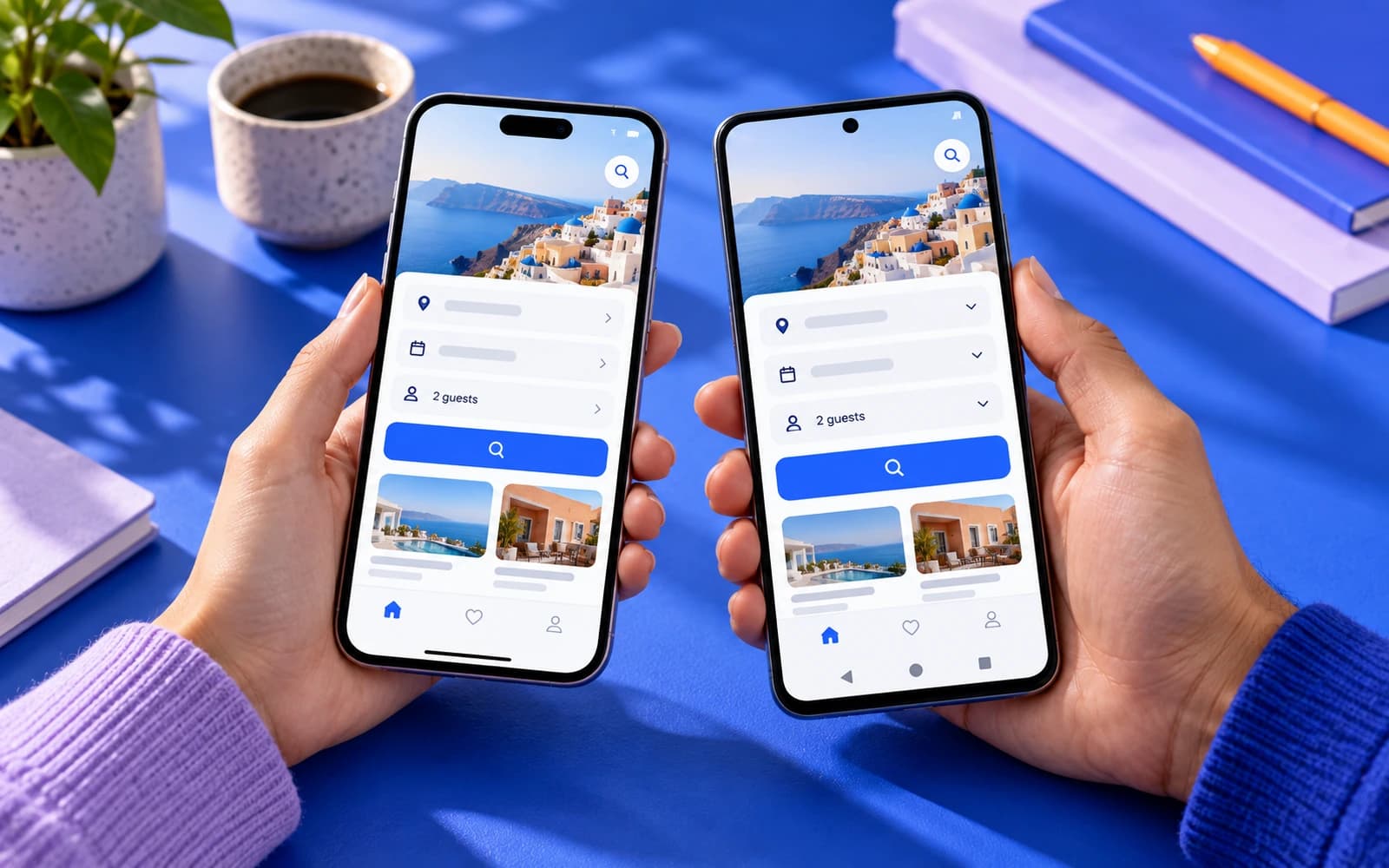
When a business comes to us asking for a mobile app, one of the first questions is: "Do you build for iPhone and Android at once, or do we have to choose?" It is almost always followed by: "And why do some people say Flutter, others say native, and everyone quotes a different price?"
We will answer honestly, without pushing a particular technology. The right choice depends on your task: sometimes that is cross-platform, sometimes native, and sometimes a Telegram Mini App.
First, what these things even are
Native development
This is when the iOS app is written in Swift and the Android app in Kotlin. Two separate apps, two skill sets in the team, two testing and support processes. Each app is built specifically for its platform and uses all of its capabilities without limits.
Cross-platform development
This is when you write the code once and run it on both platforms. The most popular tools today are Flutter from Google and React Native from Meta. The codebase is shared; the interface adapts to each system. In most cases the user does not notice the difference.
A third option: an app inside a messenger
If your customers already message you on Telegram, the app can live right inside the messenger: the catalogue, cart and personal account open from a bot button, with no install and no store review. We cover when this beats a full app in Telegram Mini Apps for business.
The main question: how much does it cost
Let us get straight to the money, because that is what most often determines the choice.
Native development for iOS and Android is effectively two separate projects: two codebases, two testing cycles, two store releases. That is why, at comparable complexity, it costs noticeably more than cross-platform. How much more depends on the project: how many screens the app has, how much logic lives on the shared backend, and how many features would have to be written separately for each platform anyway.
This does not mean native development is overpaying. It means you pay for it when the difference in quality or capabilities really matters to the business.
At Pazl an iOS and Android app on a ready platform starts from 1 000 000 ₸, and a custom app built from scratch starts from 2 550 000 ₸. We break down what makes up the final number in how much it costs to build an app in 2026.
When cross-platform is the right choice
For most business apps, cross-platform development covers the task completely. Here are the concrete scenarios.
You are launching for the first time
There is no point sinking a double budget into a product the market has not validated yet. Cross-platform lets you reach both platforms faster and cheaper, test the hypothesis on real users, and only then make decisions about further development.
The app is a channel, not the product
A customer account, a loyalty programme, online booking, the mobile version of an online store: these are tools that retain an audience. The user does not notice what the app is written in. They notice whether it is convenient, whether cashback arrives quickly and whether the payment goes through.
The budget is limited, but you need both platforms
Your customers in Kazakhstan carry iPhones as well as Android phones, and the share of each platform depends on the city and the niche. Your own split is easy to see in your website analytics. Dropping one of the platforms means losing part of your customers. Cross-platform solves this without doubling the budget.
Speed to market matters
One development cycle instead of two parallel ones. One round of testing. Updates ship to both platforms at the same time. If a competitor has already launched or the market will not wait, this matters.
That is why our default option is Flutter app development: one codebase for iOS and Android, an interface in Kazakh and Russian, and integration with your till, 1C and payments.
When native development is justified
There are situations where paying extra for native development is not overpaying but an investment with a clear return.
High performance requirements
Banking apps, fintech, complex graphics or video work, AR and VR: anywhere every millisecond affects the user experience. A native app squeezes the maximum out of the device; cross-platform a little less.
Deep device integration
Face ID, biometrics, Bluetooth, NFC, complex camera work, home-screen widgets, system-level interaction with other apps: all of these are native APIs. Cross-platform frameworks support the core functions, but in specific scenarios they can fall short. For example, when a field service app has to work reliably with a scanner or a printer over Bluetooth.
The app is the company's core product
If the app is not a channel but the business itself (a messenger, a social network, a super-app, a complex B2B platform), native development gives more control over quality and capabilities over the long term.
Fundamentally different audiences on each platform
If your iOS and Android users behave so differently that they need different interfaces, logic and features, native development lets you optimise each version separately.
When the task calls for it, we build native apps separately for iOS and for Android.
Comparing on the key parameters
| Parameter | Cross-platform (Flutter, React Native) | Native (Swift, Kotlin) |
|---|---|---|
| Code | One for both platforms | Two separate codebases |
| Cost | Lower | Higher, effectively two projects |
| Development speed | One cycle | Two parallel cycles |
| Performance | Enough for most tasks | Maximum |
| Device features | Core ones out of the box, special ones via native modules | All, without limits |
| Updates | One release for both platforms | Two releases to keep in sync |
Cost
Cross-platform is cheaper for projects of comparable complexity. The difference comes from a single team, one development and testing cycle, and a single support process.
Speed
Cross-platform is faster. One production cycle instead of two parallel ones. For an urgent market launch, that is a substantial advantage.
Quality
For most business apps, the user will not tell a cross-platform app from a native one. The difference is noticeable in specific scenarios: under high load or with deep work on the device hardware.
Support and updates
Cross-platform: a single update covers both platforms at once. Native: two independent releases that need to be synchronised. When a product is actively evolving, this doubles the operational load.
Scaling
Both approaches scale well. A cross-platform app can be moved to native development when needed, and that is a common growth strategy.
A common scenario: start cross-platform, move to native
Many companies do exactly this. The cross-platform version launches as an MVP: to test the market, build an audience and refine the business logic. When the product grows and the requirements for performance or specific features become critical, they move to native development.
This is not a lost investment. The business logic on the backend, the design, the user flows, the integrations with 1C, the CRM and payments: all of it carries over. The technology stack changes, but the product does not.
What does not depend on the technology choice
Some decisions are the same for both approaches, and it is worth making them before choosing the stack:
- Backend and data. The catalogue, orders, points and accounts live on the server, not in the app itself. The Law of the Republic of Kazakhstan On Personal Data and Their Protection requires customer data to be stored in a database located in Kazakhstan, and that applies to Flutter and Swift alike.
- Integrations. Data exchange with 1C, MoySklad, a till or a CRM runs on the backend and works the same for any app.
- Payments. Bank acquiring such as Halyk ePay, or payment through Kaspi (an invoice or a QR code), connects in both cases. For digital goods sold inside the app, the stores require their own billing.
- Languages. A Kazakh and Russian interface goes into the design from the start: texts in the two languages differ in length.
- Admin panel. Where staff change prices, offers and texts does not depend on what the app is written in.
What to choose for your business
A simple check. If your app is:
- a customer account, a store, a loyalty programme, booking or a corporate tool: cross-platform;
- a first launch that needs to validate the idea: cross-platform;
- banking, fintech, media with heavy content, AR or VR: native;
- the company's core product with an audience of millions: native;
- something that needs to be done fast on a limited budget: cross-platform;
- a catalogue and ordering for customers who already message you on Telegram: possibly a Mini App.
If after this list it is still not clear, that is normal. The right answer depends on the details of the specific project. We review the task at the first consultation and tell you directly which approach is justified and why.
What we do on this topic
Short and to the point.
Will the user actually feel the difference between cross-platform and native?
In most cases, no. Modern Flutter and React Native deliver quality indistinguishable from native for an ordinary user. The difference shows up in demanding scenarios: complex animation, heavy media work, specific system functions.
Flutter or React Native: which is better?
It depends on the task and the team. Flutter offers more design freedom and works reliably on both platforms. React Native has a mature ecosystem, JavaScript under the hood and more ready-made libraries. We build apps in Flutter, and if you already have React Native code, we will discuss that too.
Can a cross-platform app be rewritten natively later?
Yes. It is a standard growth strategy. The business logic, flows and design carry over; the technology stack changes. We help plan such a migration in advance so it does not become unexpectedly expensive.
Is native development always faster than cross-platform?
In terms of how fast the app runs, yes, native is usually a bit faster. In terms of development speed, no: cross-platform is faster, because it is one cycle instead of two parallel ones.
How much does a cross-platform app cost?
At Pazl an iOS and Android app on a ready platform starts from 1 000 000 ₸, and a custom app built from scratch starts from 2 550 000 ₸. The final number depends on screens, roles and integrations, and we fix it in the contract.
Read also
 Apps11 min readMobile app development cost in 2026: how much does it cost to build an app?What drives the cost of a mobile app in Kazakhstan: app types, what a quote includes, running costs after launch and how to compare offers from developers.
 Apps10 min readHow to make an app for my business: a 7-step guide for 2026Do you need an app at all, which business apps pay off, the seven steps from goal to launch, what drives the budget and how to choose a developer in Kazakhstan.
 Apps8 min readTelegram Mini Apps for business: sales and service right inside TelegramWhat a Telegram Mini App is and who it suits: catalogue, payment, loyalty, one-tap login, 1C and CRM integration. How it differs from a bot and a website, and the cost.
Shall we discuss your project?
We will tell you what it costs and how long it takes. The price is fixed in the contract.